Fat Truck FAQs
Fat Truck Information
Find quick answers to common questions about the Fat Truck, including its capabilities, operation, safety features, and maintenance. Learn how Fat Truck perform in challenging terrain and what is required for safe, effective use.

General Questions
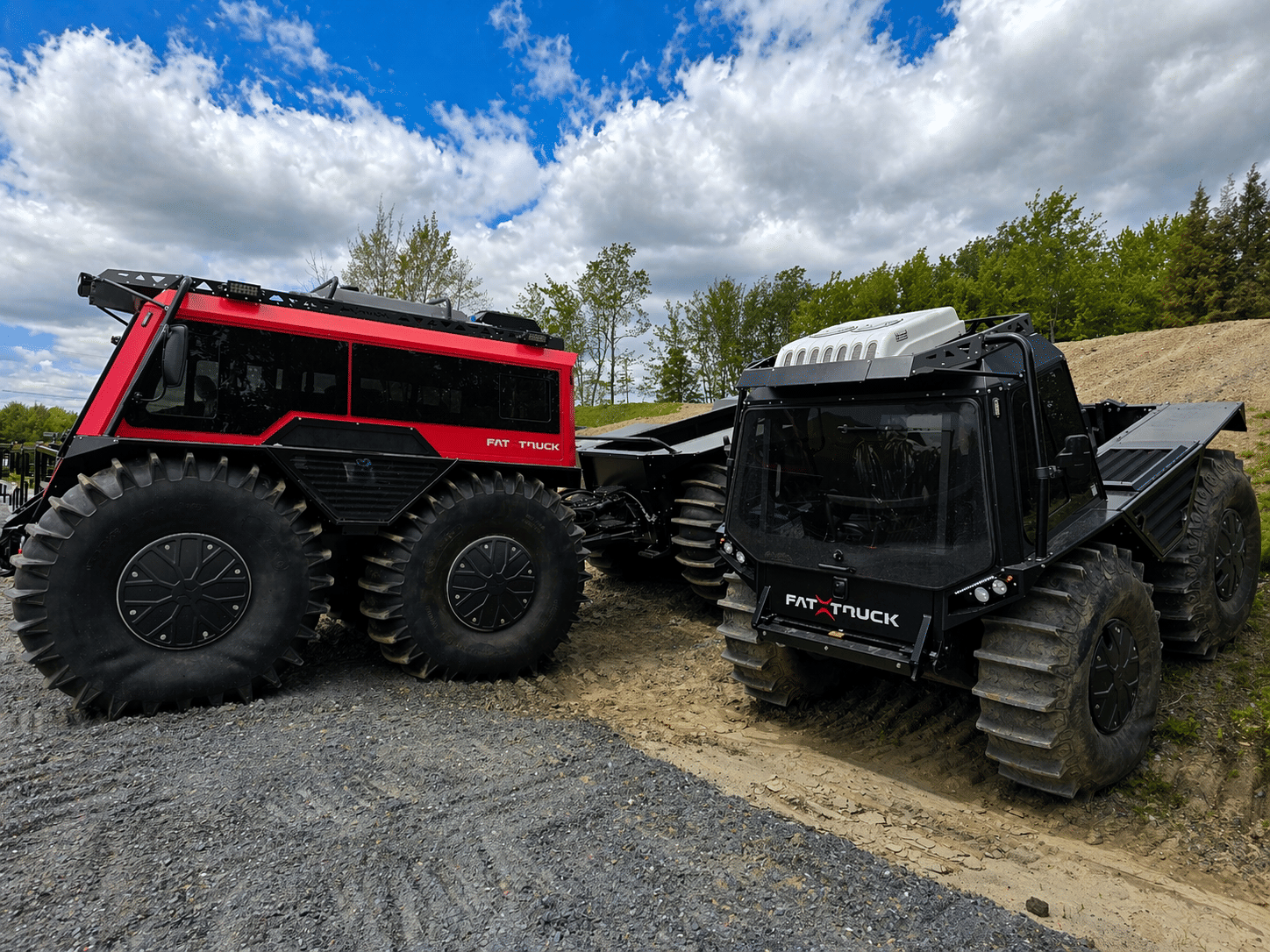
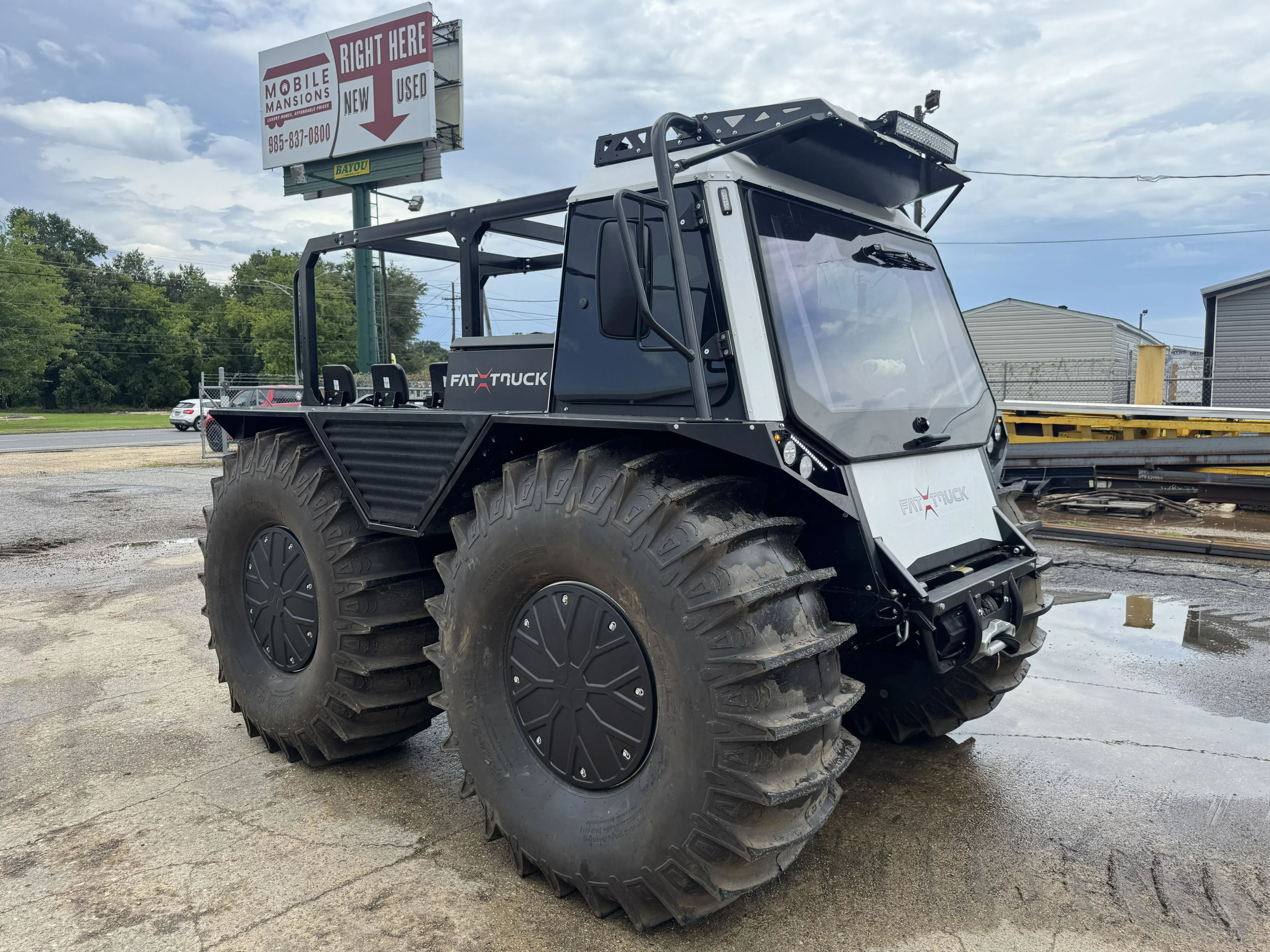
Fat Truck is an amphibious, wheeled, off-road utility vehicle designed to carry crews, tools, and equipment across terrain where conventional trucks, UTVs, and pickups cannot operate, including mud, marsh, snow, ice, and shallow water. Fat Trucks are used across North America in utilities, oil and gas, emergency response, and other demanding applications.
Compared with a UTV, Fat Truck offers much lower ground pressure, true amphibious capability, enclosed climate-controlled cabs, and higher payload and passenger capacity. Compared with a tracked machine, it travels faster, carries people more comfortably, and causes less surface damage in many soft-ground conditions. Compared with a crew boat, it can leave the water and travel directly over land, eliminating transfers between water and land vehicles.
Yes. All Fat Truck models are purpose-built amphibious vehicles that float and propel themselves in water using their low-pressure tires. They are designed for shallow water, flooded areas, marshes, ponds, and calm inland waterways, and can transition seamlessly between water, mud, snow, and solid ground.
Fat Trucks are used across North America in utilities, oil and gas, ROW access, mining, search and rescue, environmental work, survey work, and emergency response applications.
Capacity, Performance, and Specs
FT2:
2 passengers in the main cabin
2 passengers in the rear (open bed)
FT3 Wagon:
6-8 passengers, depending on configuration (all inside enclosed cabin with heat and A/C)
FT3 Pickup:
2 passengers in the main cabin (enclosed with heat and A/C)
6-8 passengers in rear seating (open bed), depending on configuration
FT5 Wagon:
4 passengers in the front unit
12 passengers in the rear unit (all enclosed with heat and A/C)
FT5 Hauler:
4 passengers in the front unit (enclosed with heat and A/C)
Rear unit is an open bed used for hauling equipment and materials
FT2: 2,000 pounds (land); 1,500 pounds (water)
FT3 Pickup/Wagon: 3,000 pounds (land); 2,200 pounds (water)
FT5 Wagon: Front unit 1,000 pounds; rear unit 3,000 pounds
FT5 Hauler: Front unit 1,000 pounds; rear unit 4,000 pounds
FT2 Pickup: 20 mph (land); 3.1 mph (water)
FT3 Pickup/Wagon: 25 mph (land); 3.1 mph (water)
FT5 Wagon: 25 mph (land); 3.1 mph (water)
FT5 Hauler: 25 mph (land); 3.1 mph (water)
Fat Trucks are engineered for mud, snow, ice, water, marsh, and rugged off-road conditions, including steep and uneven ground. Typical published limits include approximately 35° uphill/downhill and 22° side slope on recent models.
What is the ground pressure of each Fat Truck model, and how does that compare to a person walking or other equipment?
A 200-pound person standing on one foot exerts about 2.6 psi. Fat Truck models range from approximately 1.6-2.0 psi fully loaded, often lower than a person walking.
FT2 Pickup: 2.0 psi
FT3 Pickup/Wagon: 1.6 psi
FT5 Wagon: 1.9 psi
FT5 Hauler: 1.9 psi
There is no fixed depth limit, as the vehicle floats. However, safe operation depends on water conditions such as current, waves, and wind. Fat Trucks are not designed for waves or fast-moving currents. Amphibious equipment becomes difficult to control in currents over approximately 2 knots.
Safety, Compliance, and Comfort
Fat Truck is ISO-certified with a roll-over protective structure (ROPS) and seat belts for all passengers. Standard features include auto-engage braking systems, emergency brakes, horn, and interior lighting. Optional equipment includes work lights, beacons, signal lights, backup cameras, and electronic inclinometers with alarms.
Yes. Current models offer enclosed cabs with multiple heating options, air conditioning, defrost systems, and heated mirrors for all-weather operation.
Current engines are EPA Tier 4 Final / EURO Stage V compliant, which is critical for utilities, government, and industrial clients that must meet emissions regulations.
Some configurations may meet road-use requirements depending on local regulations. Customers should verify compliance with local authorities.
Basic operation can be learned quickly, but we provide a full 8-hour training session to ensure safe and effective use. We ensure all operators are fully comfortable before completion.
Controls, Operation, and Maintenance
Modern Fat Truck models use hydrostatic drive with a center-mounted joystick controller instead of a steering wheel or friction levers. This makes operation straightforward, even for inexperienced operators.
Fat Trucks use an in-cab, push-button tire inflation system with preset and adjustable settings. Operators can change tire pressure on the fly to match firm ground, soft ground, snow, or amphibious conditions.
Fuel consumption varies based on terrain, workload, temperature, and payload. Fuel capacity is designed to support a full workday (approximately 12 hours) under moderate load conditions.
Maintenance is similar to other industrial diesel equipment, including routine engine, hydraulic, tire, and driveline checks. Standard service intervals are typically 250 hours or one year for engine and hydraulic systems. The 2026 models feature reduced service requirements, with no additional major service intervals beyond standard maintenance.
Yes. Wetland Equipment provides full training, service, and parts support and can travel anywhere in the continental United States.
Configurations, Customization, and Use Cases
The lineup includes FT2 Pickup, FT3 Pickup, FT3 Wagon, FT5 Hauler, FT5 Wagon, and dedicated amphibious and transport trailers for all models.
Yes. Factory options include roof racks, storage boxes, winches, lighting, camera systems, heaters, and cold-weather packages. Wetland also specializes in custom amphibious equipment solutions such as flail mowers, brush cutters, herbicide sprayers, backhoes, augers, anchor setters, and fire suppression systems.
FT2: Best for smaller budgets, tight access areas, small crews (up to 4), and lighter payloads
FT3: The workhorse of the lineup, offering strong power-to-weight performance, seating for up to 8, flexible pickup or wagon configurations, and a 3,000-pound land payload / 2,200-pound water payload
FT5: Best for larger crews (up to 16), heavy workloads, difficult terrain, and large attachments such as cranes, manlifts, or aerial systems
Yes. Fat Trucks integrate well with existing equipment. They provide a faster and safer way to transport crews compared to UTVs and pickups and significantly reduce the risk of getting stuck. Their amphibious design allows easy transition between boats, marsh buggies, and land-based operations. The enclosed cab also improves safety and comfort in harsh environments.
Common applications include electric utility access, pipeline and oil and gas ROW work, flood response, emergency operations, surveying, and environmental work. New attachments and configurations continue to expand use cases.
Rentals, Demos, and Purchasing
Yes. Wetland maintains a rental fleet and offers equipment anywhere in the continental United States.
View our rental services.Yes. Rentals can be converted to purchase at any time, with approximately 25-50% of rental payments applied toward the purchase price. All models are eligible.
Yes, we offer free demos at our location. On-site demos are available for a fee, which may be reduced if combined with other demos or scheduled alongside transport routes.
Demos are structured around real-world performance, including terrain handling, maneuverability, and operational use based on your application.
Demo length varies depending on the terrain, evaluation goals, and scope of the demonstration.
Standard configurations are often available in stock. Units with additional factory options typically have a lead time of 6-8 weeks.
Yes. Rental fleet units are available for purchase, along with select new inventory.
Pricing, Financing, and ROI
Pricing varies widely based on model, configuration, and options. We can typically provide a quote within minutes based on your requirements.
While we do not offer in-house financing, we work with several equipment leasing partners.
A single Fat Truck can replace multiple machines, reducing trips, matting, and mobilization costs. The 2026 upgrades also reduce maintenance downtime. With modular, skid-mounted systems, one machine can perform multiple functions, reducing the need for additional equipment.
Fat Truck is designed for industrial work environments, with enclosed cabs, certified safety features, and emissions-compliant engines. Sherp is primarily designed for extreme terrain and niche or recreational applications.
Limitations and When NOT to Use It
Fat Trucks do not perform well in open, liquid “pudding” mud without vegetation for traction. In rough or fast-moving water, vehicle control becomes limited. Operators should also be mindful of environmental regulations, such as spawning seasons and required permits.
Operators must stay within payload limits, avoid slopes exceeding approximately 35° (up/down) and 22° (side slope), and be cautious of sharp objects, high winds on open water, strong currents (over ~2.5 knots), downed power lines, and large waves.
Boats: high winds or strong currents
Tracked vehicles: heavy towing (over ~10,000 lbs) or long-distance hauling
Marsh buggies: moving large volumes of spoil or heavy lifting operations
Additional Questions
Fat Trucks can be transported on a standard deck-over bumper pull trailer using a three-quarter-ton truck. Their weight typically does not require special transport permits.
No special certification is typically required beyond a standard driver’s license.
Fat Trucks are designed and built in Canada and have been proven in extreme winter conditions. They offer multiple heating options, including heated mirrors, and perform well in snow with optional tire studs for ice.
In warmer climates, they are equipped with air conditioning, engine and hydraulic cooling systems, windshield wipers and washers, and ventilation fans for reliable operation in hot and humid environments.
Reach out about our Fat Trucks
For additional questions about the Fat Truck, support, or product information, contact the team directly for assistance. You can reach out by phone or email, and a representative will respond with the information you need as soon as possible.
Disclaimer: your personal information will not be shared.
About Us
Products
Copyright© 2025 Wetland Equipment | All Rights Reserved